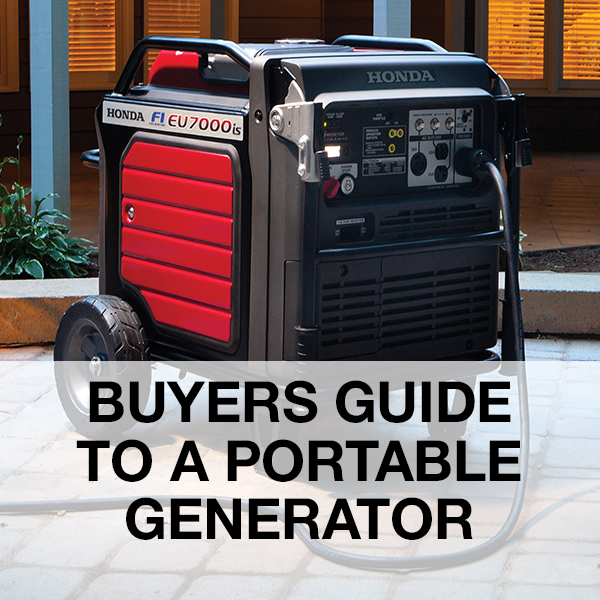

Buyer’s Guide to a Portable Generator
Buyer’s Guide to a Portable Generator – A portable generator is a major purchase. Selecting the correct model can be daunting. This guide will help you get started. There are many aspects you should consider when selecting a portable generator, including:
- Purpose or Application
- Power Requirements
- Noise Level
- Portability and Weight
- Fuel Efficiency & Run Time
- Ease of Use
Buyer’s Guide to a Portable Generator – Portable Generator Purpose or Application
Typically, applications fall into one of three categories:
- Home back up or emergency power for select appliances and heating. Power requirements and noise levels are important factors for this type of generator.
- Recreational use for your RV, camping, tailgating, and boating. Portability is the main concern for this generator.
- Industrial use such as for construction sites. These generators tend to get more use and require longer run times.
Generators are engineered towards each of these applications. However, when selecting a generator consider your individual unique needs because some models can be used in all 3 categories.
Buyer’s Guide to a Portable Generator – Portable Generator Power Requirements
Portable Generator Home Applications
To determine your basic home power needs, start with these three questions:
- Do you use city or well water? A well pump may require a larger 240 volt generator (3800 watts or above).
- Is your heating system electric, heat pump, or gas or oil forced air? Gas or oil forced air systems can get by with a very small generator. Electric furnaces and heat pumps typically need 15,000 watts or more to run and cannot be powered by a portable generator.
- Is your hot water heater electric, gas, or oil fired? Gas or oil fired heaters use as little as 2500 watts. Electric heaters often require at least 4500 watts.
Homeowners can often power most household appliances using a portable generator between 3000 and 6500 watts. See the Wattage Estimation Chart for estimates.
Buyer’s Guide to a Portable Generator – Portable Generator Recreational Applications
RVs:
The primary factor you need to consider is the size of your AC unit(s). The AC’s needs may vary based on many factors, including the ambient temperature and the efficiency of your model.
Campers, Tailgaters, and Boaters:
Light weight portable generator models of 1000-2000 watts will handle most needs. Check the power requirement of the appliances you want to use.
Buyer’s Guide to a Portable Generator – Portable Generator Industrial Applications
Industrial power needs range widely, based on what kind of tools you are using. To determine your portable generator power needs, start with the Wattage Estimation Chart to build a quick estimate
Wattage requirements for starting a tool or appliance with a motor will be much higher than the watts required to run the device. See more about starting versus running wattage below.
Buyer’s Guide to a Portable Generator – Starting versus Running Wattage
Some appliances require extra power to start up while others maintain the same power requirements constantly. Resistive load appliances require the same amount of power to both start and run the equipment such as light bulbs or a coffee maker. Reactive loads contain an electric motor, which requires additional power to start, but significantly less power to run once it gets going. Typically starting power is 3 times the amount of power to run the application such as a refrigerator, furnace fans, well pumps, air compressors and power tools.
Buyer’s Guide to a Portable Generator – Portable Generator Noise Level
The noise level of your generator is a major factor in determining the right model. Many areas have noise ordinances that may impact generator usage, particularly at night. Noisy generators are unsuitable for many applications such as camping. Generators should be labeled with a decibel rating. Models may vary, but an inverter generator with a 6500W maximum load may typically have a 60 dB(A) @ rated load comparable to an air conditioner at 100 feet. A traditional 6500W maximum generator may produce up to 75 dB(A) @ rated load which is the same rating as standing next to a washing machine.
Buyer’s Guide to a Portable Generator – Generator Portability and Weight
Consider how you will be moving and storing the generator. Larger models can weigh over four hundred pounds. Wheel kits and carts are available for both large and small models.
Buyer’s Guide to a Portable Generator – Portable Generator Fuel efficiency & Run Time
Most portable generators run on gasoline. Inverter generators are generally quieter and more fuel efficient. They are becoming available in larger models ideally suited for home and commercial use. Be sure to consult the Wattage Estimation Chart and find models suitable for your application. Commercial applications may want longer run times that would require larger fuel tanks.
Buyer’s Guide to a Portable Generator – Wattage Estimation Chart
| Contractor | Average Running Wattage | Wattage Required for Startup |
| Air Compressor, 1/2 HP | 975 | 1600 |
| Air Compressor, 1 HP | 1600 | 4500 |
| Bench Grinder, 8” | 1400 | 2500 |
| Circular Saw, 7-1/4” | 1400 | 2300 |
| Drill, 4 AMP, 3/8” | 440 | 600 |
| Drill, 5.4 AMP, 1/2” | 600 | 900 |
| Electric Chain Saw, 2 HP, 14” | 1100 | 0 |
| Electric Welder, 200 AMP AC | 9000 | 0 |
| Electric Welder, 230 AMP AC, at 100 AMP | 7800 | 0 |
| Hand Drill, 1/2” | 600 | 0 |
| High Pressure Washer, 1 HP | 1200 | 3600 |
| Table Saw, 10” | 1800 | 4500 |
| Industrial Motors | Average Running Wattage | Wattage Required for Startup |
| Split Phase, 1/4 HP | 600 | 1000 |
| Split Phase, 1/2 HP | 875 | 2300 |
| Capacitor Start, Induction Run, 1/3 HP | 720 | 1300 |
| Capacitor Start, Induction Run, 1 HP | 1600 | 4500 |
| Capacitor Start, Capacitor Run, 1-1/2 HP | 2000 | 6100 |
| Fan, 1/6 HP | 550 | 850 |
| Farm Equipment | Average Running Wattage | Wattage Required for Startup |
| Battery Charger, 15 AMP | 380 | 0 |
| Battery Charger, 60 AMP with 250 AMP Boost | 1500 / 5750 | 0 |
| Battery Charger, 100 AMP with 300 AMP Boost | 2400 / 7800 | 0 |
| Electric Fence, 25 Miles | 250 | 0 |
| Grain Cleaner, 1/4 HP | 650 | 1000 |
| Milk Cooler | 1100 | 1800 |
| Milker (Vacuum Pump), 2 HP | 1000 | 2300 |
| Portable Heater, Kerosene or Diesel, 50,000 BTU | 400 | 600 |
| Portable Heater, Kerosene or Diesel, 90,000 BTU | 500 | 725 |
* All ratings are estimates. Contact the manufacturer of your item for exact requirements.
Buyers Guide to a Portable Generator – Compare Honda Generators
Why Weingartz?
Weingartz, family owned and operated, began in 1945 as a farm supply store for local Michigan families. In the 1970s, we began to focus exclusively on outdoor power equipment. Over time, we morphed into the “power equipment superstore” that now defines all of our locations. The staff and experts at Weingartz work diligently to provide the best service possible and give honest and helpful advice to each and every customer.
Weingartz
11875 Northland Dr.
Cedar Springs, MI 49319
(616) 696-2913
info@weingartz.com
Connect With Us!
https://www.facebook.com/WeingartzLawnToSnow
http://pinterest.com/MrWeingartz
Sign up for our electronic monthly newsletter for discounts and money-saving tips.





What is the difference between the Honda eu2000i and the eu2000i companion. I am looking to use this to power my camper. Which would you recommend and what else will I need to hook up my camper?
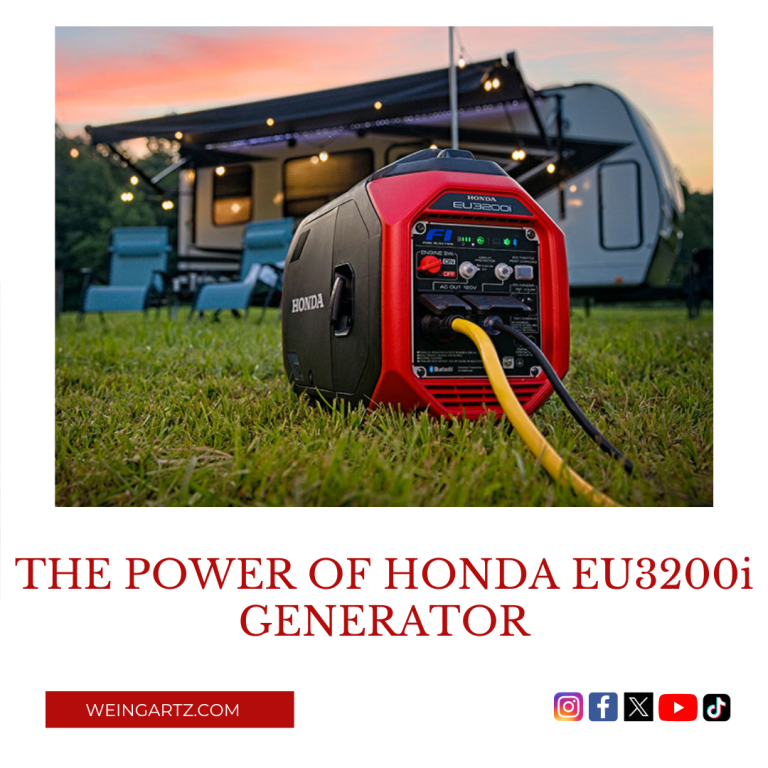
Thank you for your question, John. To answer, the EU2000i Companion includes a larger, 30-amp receptacle that you can use to run a cable directly to your camper. With a basic EU2000i, you would only be able to run extension cords to various appliances within your camper (to power lights, appliances, etc.). It is important to note that each EU2000i (and Companion) model emits 2000 watts of power, so to power your camper, you would probably need two–an EU2000i Companion connected to a basic EU2000i for a combined 4000 watts of power. Otherwise, a larger generator may be an alternative.
We hope this helps–please feel free to contact us at 855-669-7278 or by email at orders@weingartz.com with any other questions. You can also read more about the Honda EU2000i and EU2000i Companion here: http://weingartz.com/expert-advice/2013/11/honda-eu2000i-generator/ . Thank you!