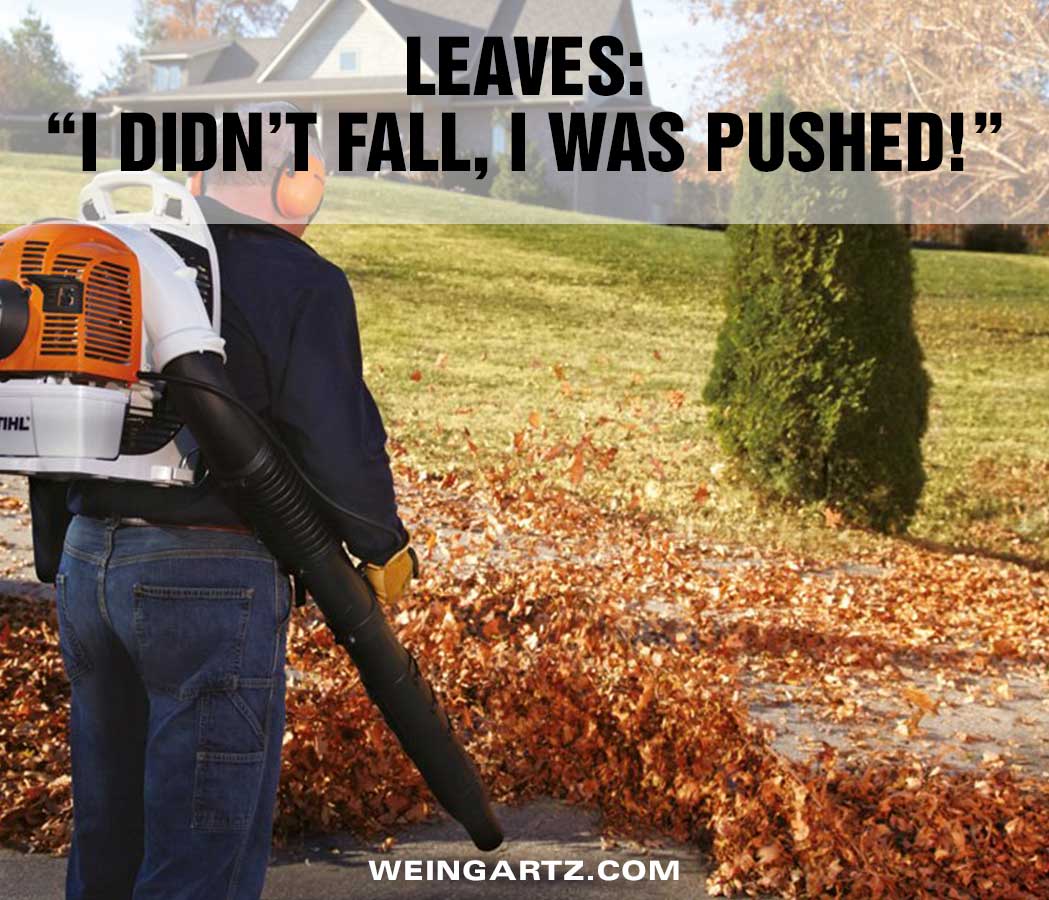

The days are getting shorter, the leaves are bursting with colors, and many of us are preparing our lawn and garden for the winter slumber. As gusts of wind swirl about our landscape, a multitude of colorful leaves fall to the ground. Contrary to most people’s belief, the wind has little to do with leaves “falling” off the tree. The tree actually cuts and pushes leaves off the tree!
We just began preparing for the cold months ahead, while our trees started this preparation at the beginning of spring. During spring growth, a separation layer called the abscission is formed at the base of each leaf and branch.
During the summer, this layer helps send water to the leaves and food back to the tree. All summer excess food is made and stored as starch until it is needed for the winter months. The shorter and cooler days of autumn trigger a hormone that sends a chemical message to every leaf; stop food production, it’s time to go.
Once this message is received, the abscission cells begin to swell where the leaf and stem meet. Within a few days or weeks, a bumpy line is developed that reduces the flow of water and food between the leaf and stem, leaving glucose and waste products trapped in the leaf.
Without fresh water to renew the leaves, chlorophyll begins to disappear. Little by little leaves are actually pushed away or off the branch!
Once those leaves hit the ground, you’ll want to remove them before snow hits the ground. When it comes to leaf cleanup, there are a few options: rake the leaves, save the leaves for mulch, or use a leaf blower.
So how do we get those beautiful colors?
Think back to your grade school science class when we learned about photosynthesis. In short, plants take in sunlight, carbon dioxide, and water. Plants produce glucose as food for energy and growing.
A chemical called chlorophyll helps make photosynthesis happen and gives plants their green color. When the chlorophyll disappears from the leaves, the bright green slowly fades away.
Now is when we begin to see the beautiful yellow and orange colors that have been in the leaves all summer, hiding under the green chlorophyll. The bright reds and purples we see in leaves are from the glucose that is trapped in the leaves. After photosynthesis stops, the glucose is turned to red. The deep brown colors are made from waste that is left in the leaves.
The combinations of all these colors give us the amazing autumn view. As we all know, Michigan is one of the best places in the world to see the burst of autumn colors.
Generally, the brightest autumn colors are seen when we have a dry late summer and bright sunny autumn days.
You can track the fall colors by going to www.michigan.org.
You May Also Enjoy These Articles:
Essential Equipment for Lawn Maintenance
How to Maintain the Perfect Lawn
Why Weingartz?
Weingartz, family owned and operated, began in 1945 as a farm supply store for local Michigan families. In the 1970s, we began to focus exclusively on outdoor power equipment. Over time, we morphed into the “power equipment superstore” that now defines all of our locations. The staff and experts at Weingartz work diligently to provide the best service possible and give honest and helpful advice to each and every customer.
Weingartz also sells parts for all outdoor power equipment at https://weingartz.com/parts-lookup.
Weingartz
39050 Grand River Ave.
Farmington Hills, MI 48335
(248) 471-3050
info@weingartz.com
Connect With Us!