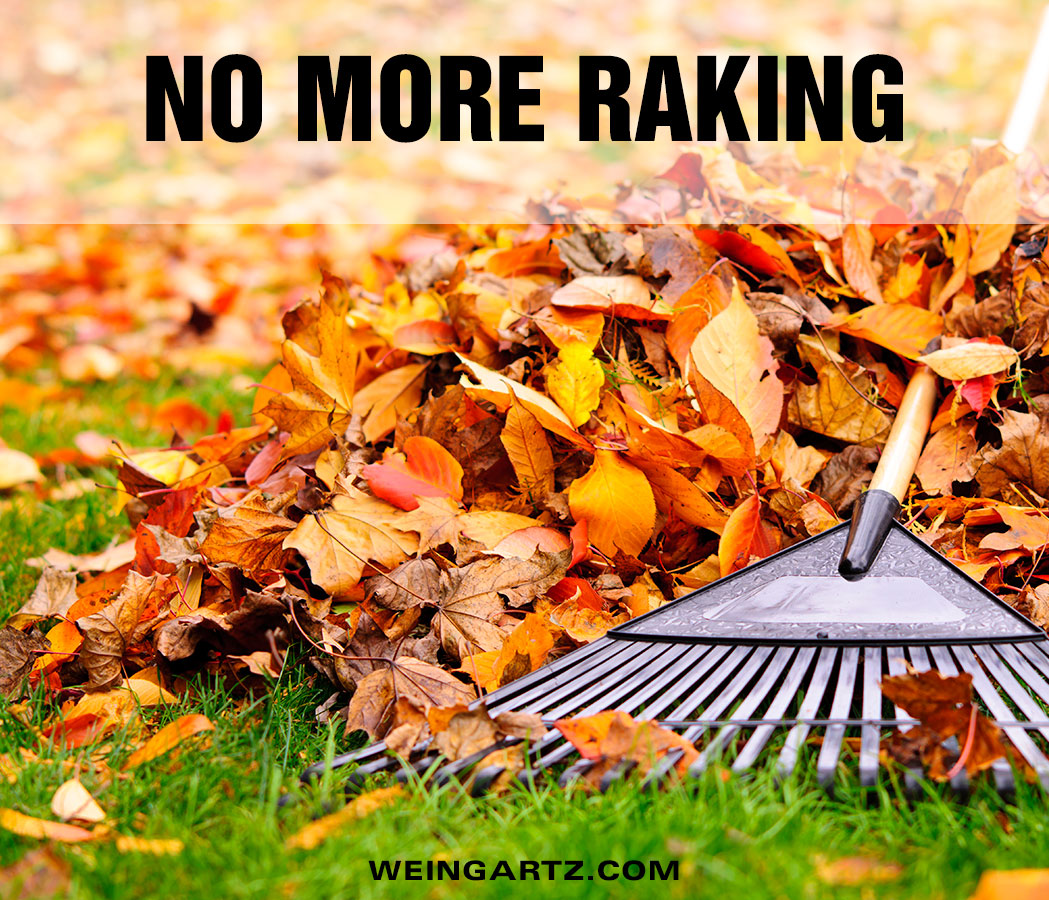

The beautiful trees that provided much needed summer shade have now turned on us. They are dropping leaves by the dozens and that means extra work outside. Yet, there is an alternative to spending your evenings and weekends battling those leaves – no more raking. Instead of raking, MULCH the leaves into the lawn.
It may sound strange, not raking the many leaves spread across the lawn, but the leaves will break down naturally so you can forget about blowing, raking, or bagging. Mulching is much easier than raking, and has more benefits. Mulching eliminates the constant motion of kneeling and bending over to gather leaves.
Mulching may actually increase the quality of your existing soil, reduce soil erosion, and protect against extreme heat and cold. Done regularly, mulched leaves do not have an adverse effect on your lawn and will not contribute to thatch.
However, if you have a thatch layer that is greater than ½ inch, it is best to dethatch your lawn before mulching. You will want to mulch when the leaves are dry and lightly covering the grass. On average this will be every 4 – 6 days. It’s important to mulch before the leaves accumulate to ¼ inch to 3/8 inch build up at one time.
If this happens, there may be more debris than your lawn can quickly absorb. Therefore, raking and bagging the leaves will be best. You will also need to bag those pine needles, because they do not break down easily into the soil.
If you are able to mulch, it is best to use a mulching mower because they are designed to shred and re-shred leaves and grass finely. This allows them to fall into the lawn and break down very easily and naturally into the soil.
A traditional side discharge lawn mower without a mulching feature may not chop the leaves finely, causing the leaves to clump and eventually suffocate parts of your lawn. When mulching, the smaller the clippings the better they are for your lawn. Find a lawn mower that will succeed in cutting clippings into tiny pieces.
After you have successfully mulched all your leaves, don’t forget to prepare your lawn mower for storage. Tasks including emptying all fuel, replacing spark plugs, and changing oil are essential to the storage process. By taking care of maintenance tasks at the end of spring, you can build a routine that will help you extend the life of your equipment. Proper storage and regular maintenance on your lawn mower also prevents issues such as defective air filters and dull blades when starting your machine next spring.
This fall, take a break from raking and mulch your leaves instead. You can visit us at weingatz.com and view more tips on lawn care and winterizing all of your outdoor power equipment.
You May Also Enjoy These Articles:
Buyer’s Guide to Walk Behind Lawn Mowers
How to Store Small Engine Equipment
Essential Equipment for Lawn Maintenance
Why Weingartz?
Weingartz, family owned and operated, began in 1945 as a farm supply store for local Michigan families. In the 1970s, we began to focus exclusively on outdoor power equipment. Over time, we morphed into the “power equipment superstore” that now defines all of our locations. The staff and experts at Weingartz work diligently to provide the best service possible and give honest and helpful advice to each and every customer.
Weingartz also sells parts for all outdoor power equipment at https://weingartz.com/parts-lookup.
Weingartz
39050 Grand River Ave.
Farmington Hills, MI 48335
(248) 471-3050
info@weingartz.com
Connect With Us!
https://www.facebook.com/WeingartzLawnToSnow
http://pinterest.com/MrWeingartz
Learn More About Brand Specific Lawn Mowers


Sign up for our electronic monthly newsletter for discounts and money-saving tips.