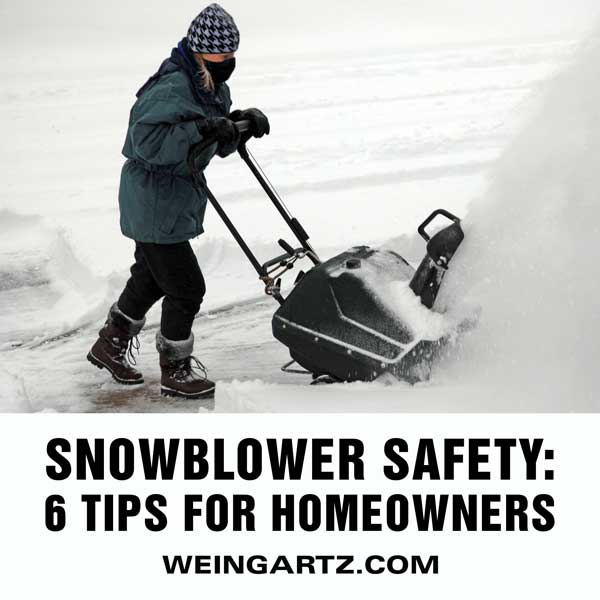

During snow season, few things lighten your workload like a powerful snowblower. The benefits of quick snow removal are time-saving when compared to shoveling, but there are also dangers to watch out for when clearing your driveway or walkway. With these snowblower safety tips, however, you can enjoy a productive, stress-free winter.
Snowblower Safety Tip #1: Consider Your Health
While snowblowers are designed for convenience, people with heart, back, or other medical conditions could be negatively impacted by physical exertion during snowblower use. Check with your doctor to see if this activity is safe for you, and consider hiring an outside service to clear your driveway if you have any concerns about your health or safety.
Snowblower Safety Tip #2: Know Your Machine
A very important component of snowblower safety involves knowing everything about the snowblower before starting it up. Study your owner’s manual, learn how to quickly shut off your snowblower in case of emergency, and make sure you understand how to use all of the features on your machine. If you’ve enlisted a friend or family member to help you, make sure that person has a complete understanding of the snowblower, as well. Do not let any child under the age of 15 operate a snowblower. For children 15 and over, make sure to go over all functions and snowblower safety rules prior to operation.
Snowblower Safety Tip #3: Know Your Surroundings
Remove any rocks, sticks, or other objects that could be picked up and thrown by the snowblower, causing structural damage or bodily harm. If you live on a steep hill, consider using an alternative snow removal method, as using a snowblower can be dangerous in places where you might lose your footing. Also, if you must use your snowblower to clear a gravel driveway, use a two-stage or three-stage snowblower that can be adjusted height-wise to pass over loose rocks. Never use a single-stage snowblower on a rocky path, as small stones will be picked up by the paddles and tossed into the air (click here to learn more about the advantages and disadvantages of different snowblower types).
Snowblower Safety Tip #4: Make Sure Everything is in Working Order
Snowblower safety depends greatly on the condition of your machine. Damaged snowblowers are more likely to malfunction, so it is important to make sure that everything is in good shape and works as it should. Make sure tires are properly inflated, check the clutch, chute, and blower system for any wear and tear, and ensure that all extension cords (for electric snowblowers) are designed for outdoor use and are not fraying.
Snowblower Safety Tip #5: Swap Loose Accessories for Protective Gear
Always wear protective eyewear (in case of flying objects), gloves, boots with good traction, and earplugs to shield your hearing from loud snowblower noise. Make sure all clothing is fitted (oversized hats, for example, can fall over your eyes and block your vision), and avoid wearing loose scarves or dangling jewelry, which can get caught in the snowblower while it is running.
Snowblower Safety Tip #6: Be Smart & Pay Attention
Do not start your snowblower inside your garage, shed, or any other indoor area. Snowblower fumes can be dangerously toxic in enclosed spaces, so always make sure you are in an open, outdoor area. After starting your snowblower, remain aware of your surroundings and stop the machine immediately if people, animals, or unexpected objects appear in your path. Always point your chute away from anything or anyone that could be damaged or hurt, be especially careful of your footing when walking on slick surfaces, and avoid operating your snowblower when bad weather obscures visibility.
Also important to remember: NEVER stick your hands or feet into the front of the snowblower—even when the machine is not running. Auger blades can continue to spin after the snowblower has been turned off, severing fingers and hands. This mishap is the number-one snowblower-related injury, but can be easily avoided. When you encounter a snow-clogged snowblower, turn off the machine and wait a minute until the blades stop spinning. Next, use a clearing tool that is specifically-designed to clear packed snow from your snowblower. Always leave safety guards and shields in place, and stay away from moving parts while the snowblower is running.
Takeaway – Snowblower Safety
Overall, becoming knowledgeable of your snowblower and using common sense will take you far when it comes to snowblower safety. Follow the rules, play it safe, and clearing snow will change from a chore to something you can look forward to.
Need help choosing a snowblower that suits your needs? Click here for our video Buyers’ Guide.
You May Also Enjoy These Articles:
Snow Blower Safety: 6 Tips For Homeowners
5 Factors When Buying A Snow Blower
6 Ways To Prepare For Winter Storms
Buyer’s Guide To A Portable Generator
Why Weingartz?
Weingartz, family owned and operated, began in 1945 as a farm supply store for local Michigan families. In the 1970s, we began to focus exclusively on outdoor power equipment. Over time, we morphed into the “power equipment superstore” that now defines all of our locations. The staff and experts at Weingartz work diligently to provide the best service possible and give honest and helpful advice to each and every customer.
Weingartz also sells parts for all outdoor power equipment at https://weingartz.com/parts-lookup.
Weingartz
11875 Northland Dr.
Cedar Springs, MI 49319
(616) 696-2913
info@weingartz.com
Connect With Us!
https://plus.google.com/+weingartz
https://www.facebook.com/WeingartzLawnToSnow
https://www.twitter.com/Weingartz
http://pinterest.com/MrWeingartz
https://www.youtube.com/user/WeingartzLawnToSnow
Learn More About Brand Specific Snow Blowers:


Sign up for our electronic monthly newsletter for discounts and money-saving tips.




i have a toro snowthrower ccr 2450 model 38516. the other day while trying to start the rope cord pulled out and will not retract into the reel. this snowthrower has very few hours on it so i was surprised that this happened. I can still use the electric start but would like to have the pull cord option also working. any advise on how i can fix this? Thanks, Don Olson, oakland, mi 586 752 7919
Hi, Don:
Thanks for your question. From what you have described above, we are fairly certain that something has broken inside the recoil. The recoil (part number 801242, manufactured and sold by Briggs & Stratton) is sold only as a complete replacement assembly, but we are currently out of stock. As of now, our distributor unfortunately has no ETA for when we can expect the part back in stock. We apologize for the inconvenience and hope this information helps. Please let us know of any other questions you may have.